In short:
- If you sell to a European buyer, it's usually them who is liable as the operator under the EUDR, not you.
- Their compliance depends on the data you give them, which depends on your own suppliers all the way to the plot.
- Mass balance is not allowed: physical segregation is required, batch by batch.
- Ask in writing for: the DDS reference number, geolocation, confirmation of no mixing, and verifiable contact details.
- If you're not an SME, register in the EUDR Information System (Art. 5(2)).
- Keep all documentation for five years.
A cocoa exporter buys from five local agents, each with their own network of smallholders. They assume that, since their agents have been selling to Europe for years, everything must already be in order. The shipment reaches European customs and gets held: one of the agents had never submitted a due diligence statement, and nobody had asked before.
This scenario isn't an exception. Roughly 60% of the world's coffee comes from smallholders with plots under 5 hectares, and a single export container can hold beans from hundreds of different farmers. In cocoa, Côte d'Ivoire and Ghana together produce around 60% of the world's cocoa, most of it passing through intermediaries. In palm oil, barely 0.2% of smallholders sell directly to the mill. In rubber, around six million smallholders produce 85% of the world's natural rubber, almost always selling through intermediary agents before it reaches the processing plant. If you export this way, you're not the exception. You're the norm.
First, what are you in this chain? (and why you're probably not the operator)
Article 2 of the EUDR distinguishes several roles, and confusing them is the first mistake:
- Operator, if you place the product on the European market for the first time or export it, with no prior declaration.
- MSPO (micro or small primary operator), if you're a natural person or a very small company, in a low-risk country, exporting directly and producing the raw material yourself.
- Downstream operator, if you place or export a product already covered by another company's declaration.
- Trader, if you distribute a product someone else already placed on the market, without transforming it.
The operator is whoever is listed as the importer on the customs declaration for release into free circulation in the EU. If it's your European buyer who handles that step, they're the one liable under the EUDR, not you. You would only be the operator if you yourself handled the import with your own customs procedures and an EU EORI number, which requires infrastructure most exporters neither have nor need to build.
This doesn't let you off the hook in practice: your buyer's compliance depends entirely on the data you give them, which in turn depends on your own suppliers or intermediaries, all the way to the plot. If a single data point is missing anywhere along the way, your buyer can't comply, and your shipment gets held. Not because you're the operator, but because you're the one holding the information it depends on.
If you're a cooperative: MSPO or authorised representative, and how to choose
The rule for deciding is simple: if the cooperative directly produces what it exports, it can qualify as an MSPO and submit a single simplified declaration. If it's the members who produce, and the cooperative just aggregates the harvest and handles the paperwork, the right path is to act as an authorised representative: submitting the DDS or simplified declaration on behalf of each member.
Watch out for the opposite mistake: declaring yourself an MSPO without meeting all four real requirements (size, low-risk country, direct export, own production) is one of the most repeated signs of non-compliance.
Why every intermediary you add increases risk, according to the regulation itself
Supply chain complexity is, literally, one of the risk assessment criteria required by Article 10(2) of the EUDR. The logic is simple: the more processors and intermediaries there are between the plot and the operator, the harder it is to trace the product back to its origin, and that alone is considered a higher-risk factor, even if every individual link is perfectly compliant.
The official guidance itself gives a list of questions to assess whether your chain is complex. It's worth asking them yourself before a competent authority does:
- Were there several processors or steps in the chain before the product reached the European market?
- Does the product mix raw material from several plots or several countries of production?
- Is it a highly processed product, which may itself contain other relevant products?
- If you export wood: does the product contain more than one species? has it been traded in more than one country? was it processed in a third country before reaching the EU?
The more affirmative answers, the higher the level of scrutiny your European buyer has to apply, and the more important it is that you can demonstrate, with data, every step of the chain we covered in the previous section.
There's a real exception that connects to the above: if you qualify as an MSPO, or if your supplier sources exclusively from a low-risk country, this complexity assessment doesn't apply to you at all, unless you have indications that something is wrong. Confirm first whether that's your case, before spending time analysing the complexity of the whole chain.
Why mass balance isn't enough
This surprises even those already working with certifications: the EUDR does not allow mass balance that mixes compliant product with material of unknown origin, something other schemes common in coffee, cocoa, palm oil and rubber do accept. It requires real physical segregation, batch by batch: each batch has to be traced individually back to its plot. If a mixed batch is linked to several plots and just one fails to comply, the whole batch becomes non-compliant. This is exactly the case with silos and tanks shared by several intermediaries: you can see the specific rule that applies in our article on the 200% silo rule.
What to ask for, and what to register
If you can't obtain the required data, neither you nor your buyer will be able to export that product (Art. 5(1)). Ask, in writing and before closing the purchase (you can see the detail on how to collect this data in our article on geolocation without professional GPS), for:
- Their DDS reference number (or simplified declaration identifier if they're an MSPO).
- The geolocation of each plot of origin.
- Explicit confirmation that your order isn't mixed with unknown origin.
- Their verifiable contact details.
If your company isn't an SME, you also have to register in the EUDR Information System (Art. 5(2)) and actively verify this information, not just collect it.
The "first downstream operator", and when your good faith stops being enough
If your direct supplier is an operator, they must proactively give you their DDS reference number (Art. 4(7)); at that moment you become a "first downstream operator" or "first trader". You don't have to chase that data down, unless you already have concrete reasons to suspect otherwise: invoices that don't match the volume claimed, an agent who never mentions TRACES NT, an unusually low price, or someone presenting themselves as an MSPO without meeting all four requirements.
If you don't receive the reference number, you can assume in good faith that your supplier isn't subject to that obligation. Legally, that's enough. As a business strategy, it isn't: good faith protects you from a penalty, not from a batch getting held. It's exactly what happened to the cocoa exporter at the start: it took weeks to reconstruct the documentation their agent never had, while the container sat held at the port.
Collecting and keeping, with no exception by country
As an SME trader or downstream operator, you don't have to verify every DDS number: it's enough to be able to retrieve it if an authority asks, and keep it for five years (Art. 5(3) and (4)), with the same timeframes we detail in our article on the 4 guarantees per plot. And this doesn't change for working with a low-risk country: there's no exception to geolocation traceability based on country risk.
If you're not an SME, the obligation goes up a level in one specific case: when there's a substantiated concern about a supplier in your chain (Art. 5(6)), you have to actively verify that due diligence was exercised and that the risk is null or negligible, not just keep the data in case it's requested. If that verification doesn't confirm it, you can't market or export that product.
How Retexcycle solves it
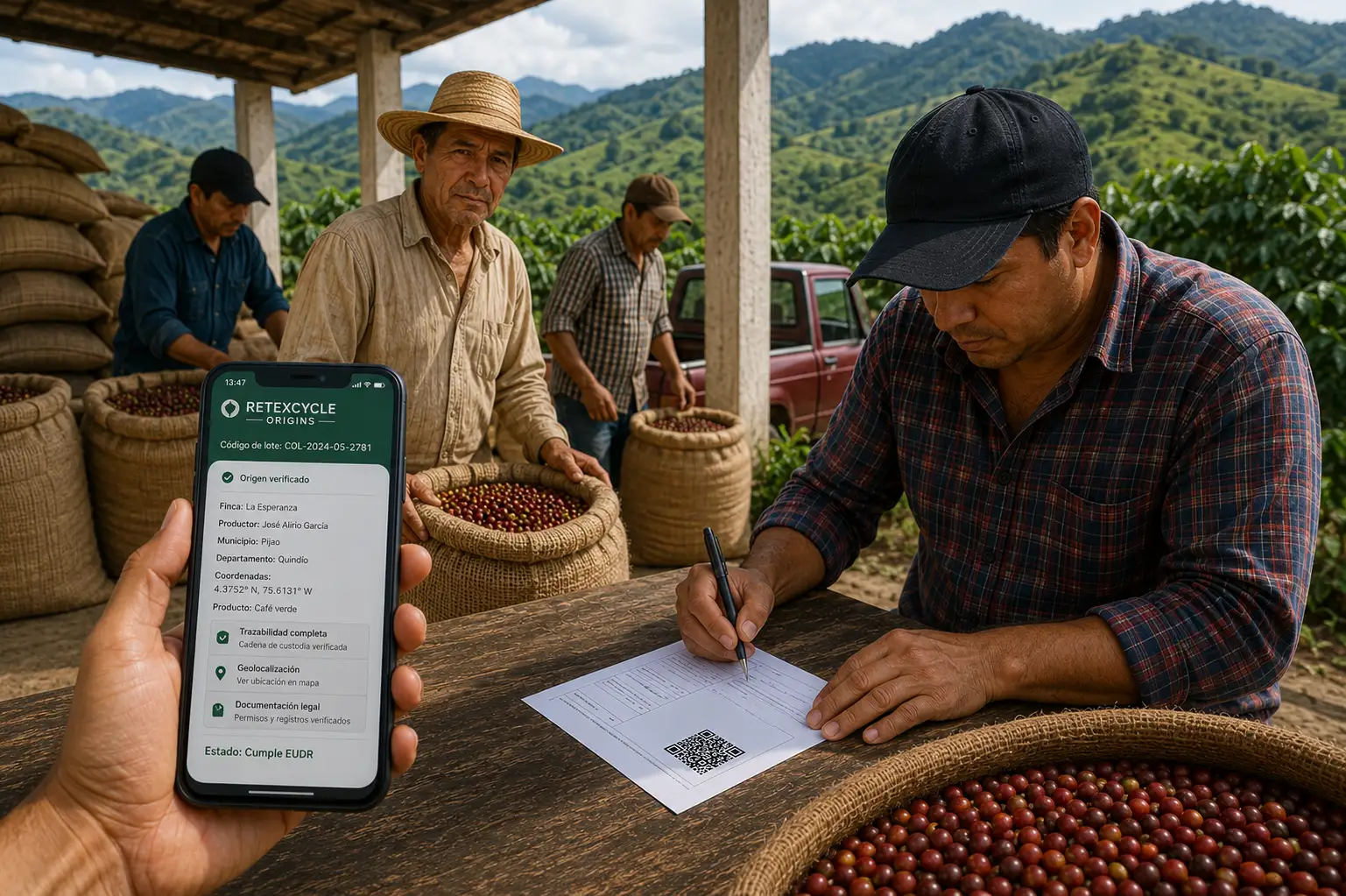
Retexcycle Origins guarantees preserved identity throughout the entire chain, without losing it across multiple intermediaries. This is how it works, step by step:
Step 1. The exporter or relevant company registers all producers and their plots. A deforestation and risk analysis is carried out, and due diligence questionnaires are completed to confirm everything meets the established requirements.
Step 2. Every collection is recorded through a QR code assigned to each producer, and stored with a unique, tamper-proof alphanumeric code, linked to that plot's geolocation.
Step 3. This is where the trail actually gets lost in a chain with intermediaries, so it's the step Retexcycle gives the most weight: every blend, transformation and shipment that passes through an agent, a collection point or a cooperative is recorded with its own unique code, respecting the exact quantities of each batch and preventing overflow. So even if a batch passes through three or four intermediaries before reaching your buyer, preserved identity doesn't break at any of those steps.
Step 4. All documentation is archived for as long as the regulation requires.
The result: when your European buyer asks for evidence about a specific batch, that code lets you reconstruct its entire journey back to the plot in minutes, no matter how many intermediaries were involved. With Retexcycle Compliance Hub, that reference number and geolocation reach the buyer already connected, with no need to chase them supplier by supplier.
What to do this week
- Cooperative: decide between MSPO or authorised representative based on who produces.
- Non-SME: confirm your registration in the EUDR Information System.
- SME: check whether you have, in writing, the four things to ask each supplier.
- Everyone: check whether your chain maintains real physical segregation.
If you want to see how your chain's traceability with intermediaries would work in practice, you can request a demo with your own data.