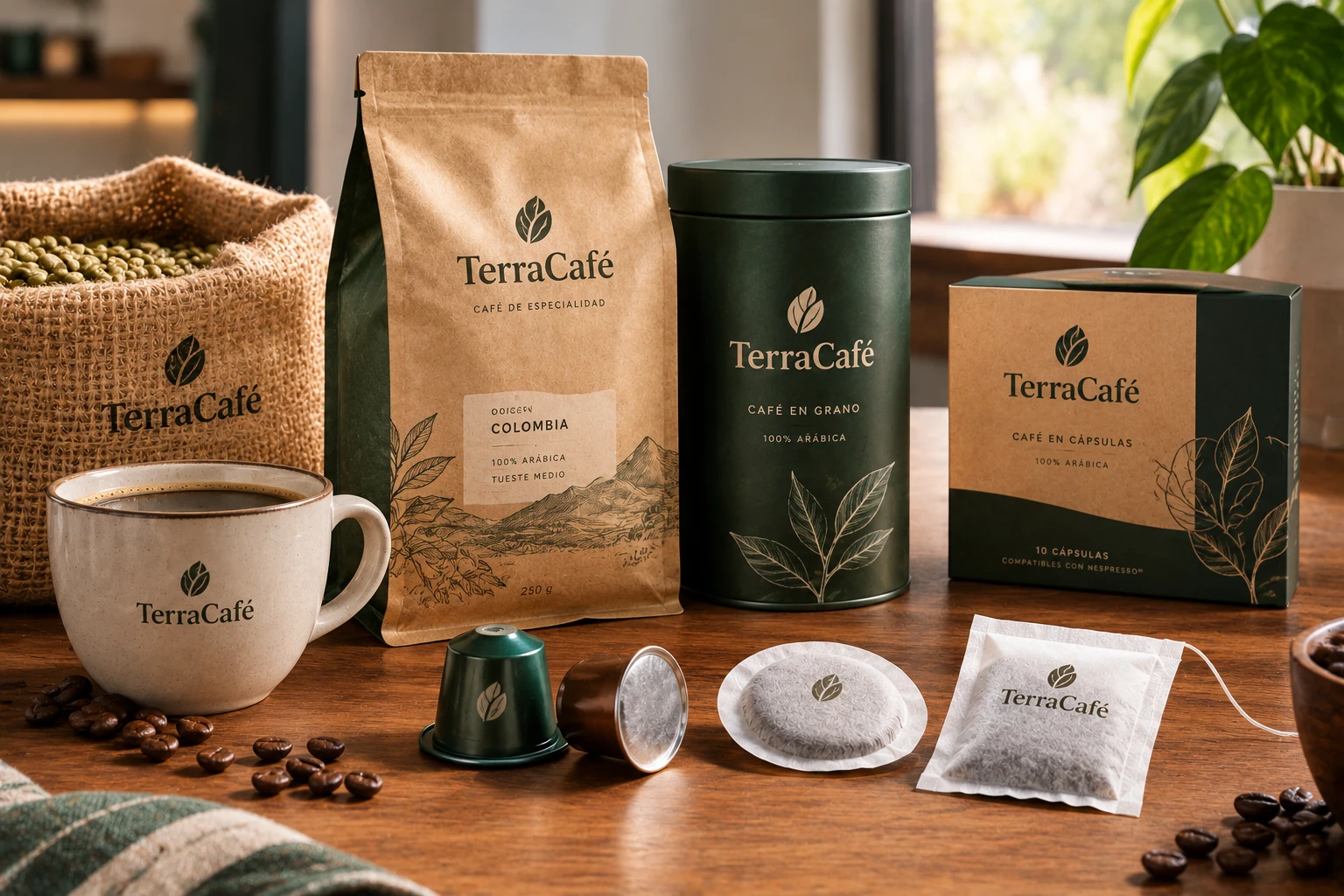
If you roast, import or sell coffee under your own brand, the Packaging Regulation affects you from 12 August 2026, and not just on the bag: capsules, filter sachets, green-coffee sacks and pallets are packaging too. This summary covers the essentials and where to start.
Short answer
- From 12 August 2026, capsules, filter sachets, pads, roasted-coffee bags, tins, sacks and pallets are packaging under Regulation (EU) 2025/40 (PPWR) and already carry obligations.
- Compostable from 12 February 2028: only filter sachets, infusion bags and soft pads. Rigid plastic capsules, only if your Member State requires it; aluminium or steel capsules, never.
- The roasted-coffee bag must be recyclable (grade A, B or C) from 2030, or 24 months after the delegated act if later; from 2038, only A or B.
- Cafés must accept the customer's own container at no extra charge from 12 February 2027.
Who signs
The legal manufacturer is whoever puts their name or brand on the packaging, whether they make it themselves or a third party does: they prepare the technical documentation and sign the EU declaration of conformity (Art. 3(1)(13)). There is only one per package.
| Your situation | Who signs |
|---|---|
| You roast and sell under your own brand | You, even if someone else produces the packaging |
| You pack under contract | Whoever puts their name or brand on it; the contract can split tasks, not responsibility (Art. 39(4)) |
| You import product that is already packed | The company of origin is the manufacturer; you, as importer (established in the EU), check their documentation, add your name and address and keep the declaration for 5 years (Arts. 3(1)(17) and 18) |
What is required from 12 August 2026
- Metals: lead, cadmium, mercury and hexavalent chromium, 100 mg/kg maximum in total (Art. 5(4)).
- PFAS in food-contact packaging: 25 ppb per PFAS, 250 ppb for the sum and 50 ppm in total (Art. 5(5)). No harmonised test method and no transition period; products placed on the market before 12 August 2026 may still be sold.
- Technical documentation and EU declaration for each packaging type, drawn up and signed by the manufacturer without a notified body; kept for 5 years (Arts. 15, 38 and 39).
- Identification and traceability: type, batch or serial number and manufacturer details on the packaging; 10 days to respond to the authority; being able to name suppliers and customers (Arts. 15 and 22).
If documentation is missing, the authority requires it to be corrected and may prohibit, withdraw or recall the packaging (Art. 62). National penalties for failing substantive requirements must be in place before 12 February 2027 (Art. 68).
Single-serve formats: what must be compostable
| Format | Compostable? | From |
|---|---|---|
| Filter sachet, infusion bag, drip bag | Mandatory | 12 February 2028 |
| Soft pad | Mandatory | 12 February 2028 |
| Rigid plastic capsule | Only if the Member State requires it | Depends on the Member State |
| Aluminium or steel capsule | Never | — |
Anything that is not compostable must be recyclable (Art. 6), even if the material is biodegradable. EN 13432 is a reference, but a certificate does not by itself give a presumption of conformity. Ask your supplier for the compostability certificate (sachets, pads) or recyclability test reports (capsules).
Roasted-coffee bag and tin
Recyclability is measured in grades: A (95% or more), B (80%) and C (70%); below 70% the packaging cannot be placed on the market. The minimum applies from 1 January 2030, or 24 months after the delegated act setting the criteria if later; from 2038 only A and B count. The whole bag is assessed (body, barrier, valve, closure, label, inks and adhesive). A plastic jar or tin in contact with food must contain, from 2030, 30% recycled plastic if it is PET and 10% if not (50% and 25% from 2040); plastic parts under 5% of the weight, such as a valve, are excluded (Art. 7).
Green coffee and logistics
The green-coffee sack is transport packaging: assessment and declaration from 2026, with no reuse target (Art. 29(4)). The rest of transport packaging (pallets, boxes, straps and film) must be reusable at least 40% from 2030, and 100% between sites of the same operator or linked companies, or to another operator in the same Member State; pallet wrapping and straps are exempt from the 100% (Commission Delegated Decision (EU) 2026/429).
Cafés and online sales
- 12 February 2027, “bring your own container”: accept the customer's container, at the same price and with signage. No exemption for micro-enterprises (Art. 32).
- 12 February 2028: also offer a reusable option; micro-enterprises are exempt (Art. 33).
- 1 January 2030: single-use plastic packaging is banned for on-site consumption, except where there is no drinking water, and so are single-serve portions of sugar, cream and sauces in plastic (Annex V.3-4).
- Online shop, 2030: maximum 50% empty space in the shipping package; if you ship the sales packaging as-is as the shipping package, you are exempt from the 50% but not from minimising (Art. 24). Selling to consumers in another Member State makes you a producer there, with an authorised representative if you are not established (Art. 45(3)).
The EU Deforestation Regulation (EUDR) is a separate file: it concerns the origin of the coffee, not the packaging. It applies from 30 December 2026 (30 June 2027 for micro and small enterprises) and to instant coffee from 30 December 2027.
Calendar
| Date | What happens |
|---|---|
| 12 August 2026 | General application: PFAS, metals, documentation and declaration |
| 12 February 2027 | “Bring your own container” in cafés; national penalties |
| 12 February 2028 | Compostable sachets and pads; reusable offer; minimum empty space in sales packaging |
| 1 January 2030 | Recyclability A–C, recycled plastic, on-site bans, 50% empty space in shipments, reusable transport packaging |
| 2035 · 2038 | Recyclability at scale · only grades A and B |
Several dates depend on Commission acts that are still pending: check on EUR-Lex which ones have already been published.
Where to start
- Inventory of formats, with the weight and material of each component. In the Retexcycle Compliance Hub PPWR you register each reference with its components.
- Role per format: does it carry your brand? That decides who signs. Retexcycle's questionnaire works out your role and each question cites its article.
- Suppliers: declaration of conformity, PFAS and metals test reports, recyclability or compostability evidence. The Hub gives you the list of documents per package, who issues them and when they expire.
- Technical documentation and EU declaration per packaging type. Retexcycle generates the package for your importer with declaration and documentation templates; if anything is missing, it is marked as incomplete.
If you want to know first how much is missing, take Retexcycle's free 16-question pre-assessment.
Need the detail by format? The PPWR guide for coffee (free PDF) covers it with the legal basis for each point.
Retexcycle Compliance Hub PPWR
Want to know what applies to your own packaging?
Start with one package: download the coffee guide, take the 16-question pre-assessment or request a demo of the Compliance Hub PPWR.
Frequently asked questions about the PPWR for coffee
Are coffee capsules packaging under the PPWR?
Yes. The Regulation expressly names rigid capsules, filter sachets and soft pads as packaging (Art. 3(1)(1)). From 12 August 2026 they need assessment, substance limits and an EU declaration.
Do coffee capsules have to be compostable?
It depends. Aluminium or steel ones, never; rigid plastic ones, only if your Member State requires it; filter sachets, infusion bags and soft pads, yes, from 12 February 2028.
Does the coffee bag have to be recyclable?
Yes. From 2030 (or 24 months after the delegated act, if later) at least grade C; from 2038, only A or B. The whole bag is assessed.
Who signs if I buy roasted coffee from a third party under my brand?
You do: whoever commissions the product or packaging under their name or brand is the legal manufacturer (Art. 3(1)(13)).
What must a café do before February 2027?
Offer a system for customers to bring their own container, at the same price and with signage that says so. In 2028, also a reusable option (micro-enterprises exempt).
Checked against the official text of Regulation (EU) 2025/40 in October 2026. For information only, not legal advice; deadlines that depend on pending Commission acts may change. Sources: Regulation (EU) 2025/40; Commission guidance C/2026/3084 (OJ, 10/06/2026); Delegated Decision (EU) 2026/429.