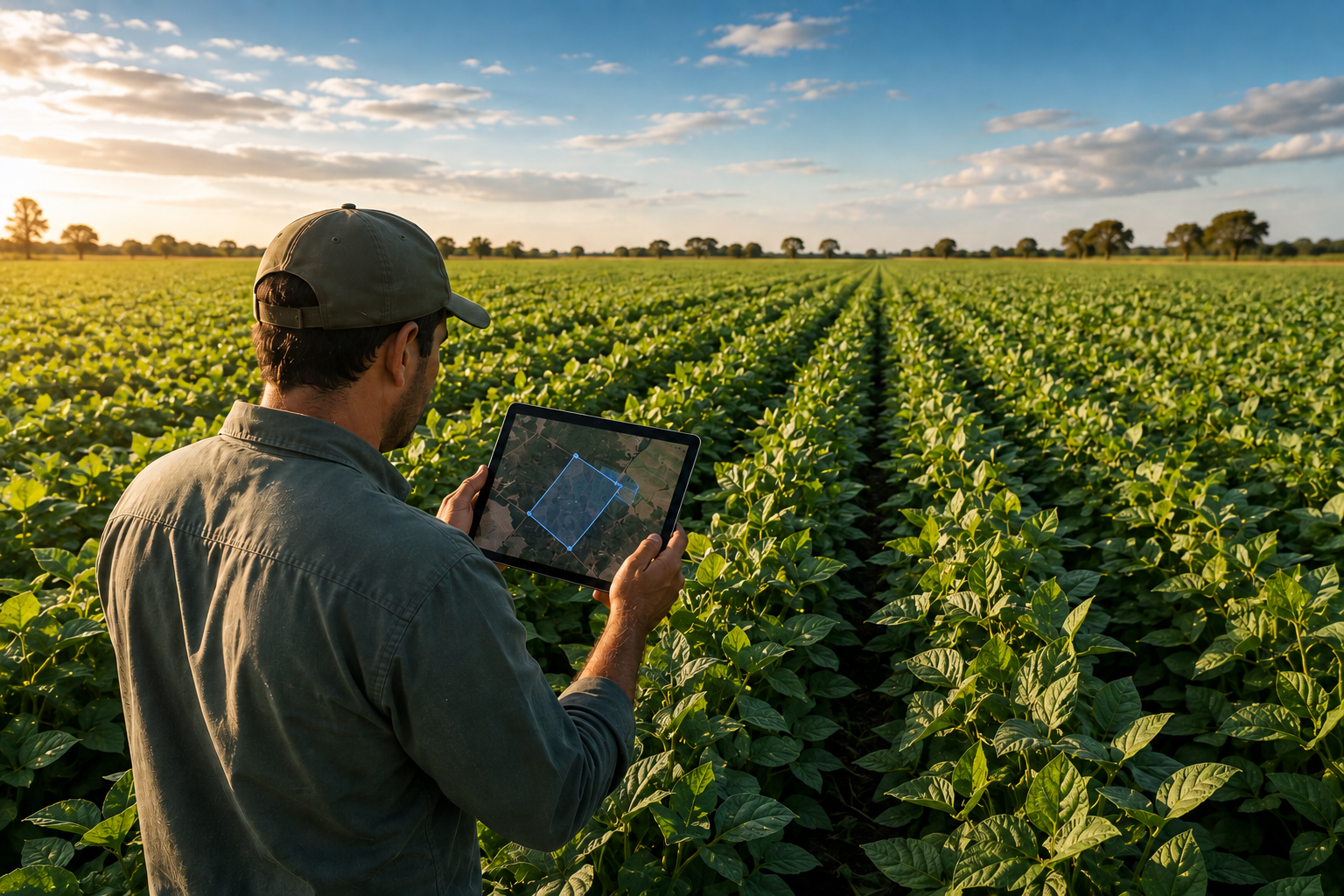
Complying with the EUDR from origin means guaranteeing four specific things for every plot that's part of your export, before the product leaves for Europe: verified geolocation (no exception by country), proof of land legality, evidence of production date, and traceability without mixing with unknown origin. Having them isn't enough: you need to be able to prove them, for five years, if a buyer, an auditor or a competent authority asks. A single due diligence statement can cover several shipments, but within it these four things must be guaranteed for every plot that contributed to the product.
1. Verificar la geolocalización EUDR, no solo tomarla
No es suficiente con tomar una coordenada. El Artículo 2(28) del Reglamento (UE) 2023/1115 exige que tenga seis decimales de precisión, que corresponde al formato correcto según el tamaño de la parcela (un punto si es menor de 4 hectáreas, un polígono completo con todos sus vértices si es mayor), y que se comprobó en el momento de la recolección, no reconstruida semanas después a partir de una memoria o un mapa aproximado.
A common doubt worth clarifying: there is no exception to this requirement for coming from a country classified as low risk. The country of origin's risk classification doesn't matter: geolocation is always mandatory for every plot, without exception.
2. Confirm land legality, without demanding more than necessary
You need to verify that the producer can legally sell their crop under the law of their country, even without a formal land title or the plot being registered in a land registry. Without that verification, the EUDR's legality requirement is left hanging. What matters here is not confusing "no paperwork" with "not complying with the law": these are different things, and the EUDR only requires the latter.
What actually counts as evidence of legality: that the supplier has all documentation proving compliance with applicable legislation available and immediately verifiable when requested. If those documents are ready when asked for, it's a sign the chain is well established. You also need to consider indicators from the country of origin, such as corruption levels or business risk indices, because they can weaken the reliability of documents even when they exist.
This assessment is what determines whether the risk is "negligible": a conclusion reached after the analysis, not a box ticked by default, nor something a country or commodity can be assigned automatically.
3. Prove the production date, don't assume it
Hay que poder acreditar que la materia prima procede de tierra que no fue deforestada ni degradada después del 31 de diciembre de 2020, fecha de corte fijada en el Artículo 2 del Reglamento (UE) 2023/1115. Esa fecha se refiere al momento de producción de la materia prima, no al momento en que se comercializa ni al momento en que se exporta. No basta con asumir que la finca "siempre ha sido así": hace falta la evidencia que lo respalde, normalmente cruzando la geolocalización con imágenes satelitales de cobertura forestal.
4. Guarantee continuity without mixing, at every transformation
From the moment origin data is collected until the product reaches the European buyer, you need to check that it's never mixed with raw material of unknown provenance at any point. This includes collection, blending at a mill or silo, and any intermediate transformation. A single unverified point invalidates the entire resulting batch, not just the portion from that unknown origin.
What to do if a supplier doesn't give you one of these four pieces of data: the rule is clear and leaves no room for interpretation. If you can't obtain the information the regulation requires, you must refrain from placing or exporting that product. Attempting to do so without that information is, in itself, a breach.
Cuánto tiempo hay que conservar la evidencia de diligencia debida EUDR
El Artículo 9 del Reglamento (UE) 2023/1115 obliga a recopilar y conservar esta información. No basta con reunir estos cuatro elementos una vez: hay que conservarlos durante años, y el plazo cambia según qué documento sea:
| What is kept | How long | Since when |
|---|---|---|
| Due diligence documentation and mitigation measures | 5 years | From when due diligence was exercised |
| Record of the due diligence statement itself (DDS) | 5 years | From its submission in TRACES NT |
| Evidence of correspondence between what's declared and what's actually exported | 5 years | From the date of placing on the market or export |
If a competent authority asks for this evidence three years after a shipment, you need to be able to show it just as you could on day one.
How Retexcycle Origins guarantees these four elements
Retexcycle Origins resolves these four points as part of a single flow, not as separate steps. This is how it works in practice:
Step 1. Legality and risk, verified before starting. The exporter or relevant company registers all producers and their plots. A deforestation and risk analysis is carried out, and due diligence questionnaires are completed to confirm everything meets the established requirements.
Step 2. Geolocation, captured at the collection point. Every collection is recorded through a QR code assigned to each producer, and stored with a unique, tamper-proof alphanumeric code, linked to that plot's geolocation.
Step 3. Continuity, without losing batch identity. Every blend and every shipment is recorded with unique codes, respecting the quantities of each collection or batch and preventing overflow. This is how preserved identity is guaranteed throughout the entire chain.
Step 4. Evidence available for five years. All documentation is archived for as long as the regulation requires.
The result: when an authority or a buyer asks for evidence about a specific batch, that code lets you reconstruct its entire journey in minutes, without digging through folders or asking anyone.
Why this can't be left until the last minute
These four elements aren't gathered overnight once it's time to export. They're built throughout the entire chain, from collection to delivery, and the sooner they're integrated into everyday working processes, the less reconstruction work is needed when it's time to declare.
Less than five months remain until 30 December 2026, the application date for large and medium operators. If you want to see how these four guarantees would work in your own chain, you can request a demo with your own data, or check the rest of our frequently asked questions about the EUDR on our frequently asked questions page.