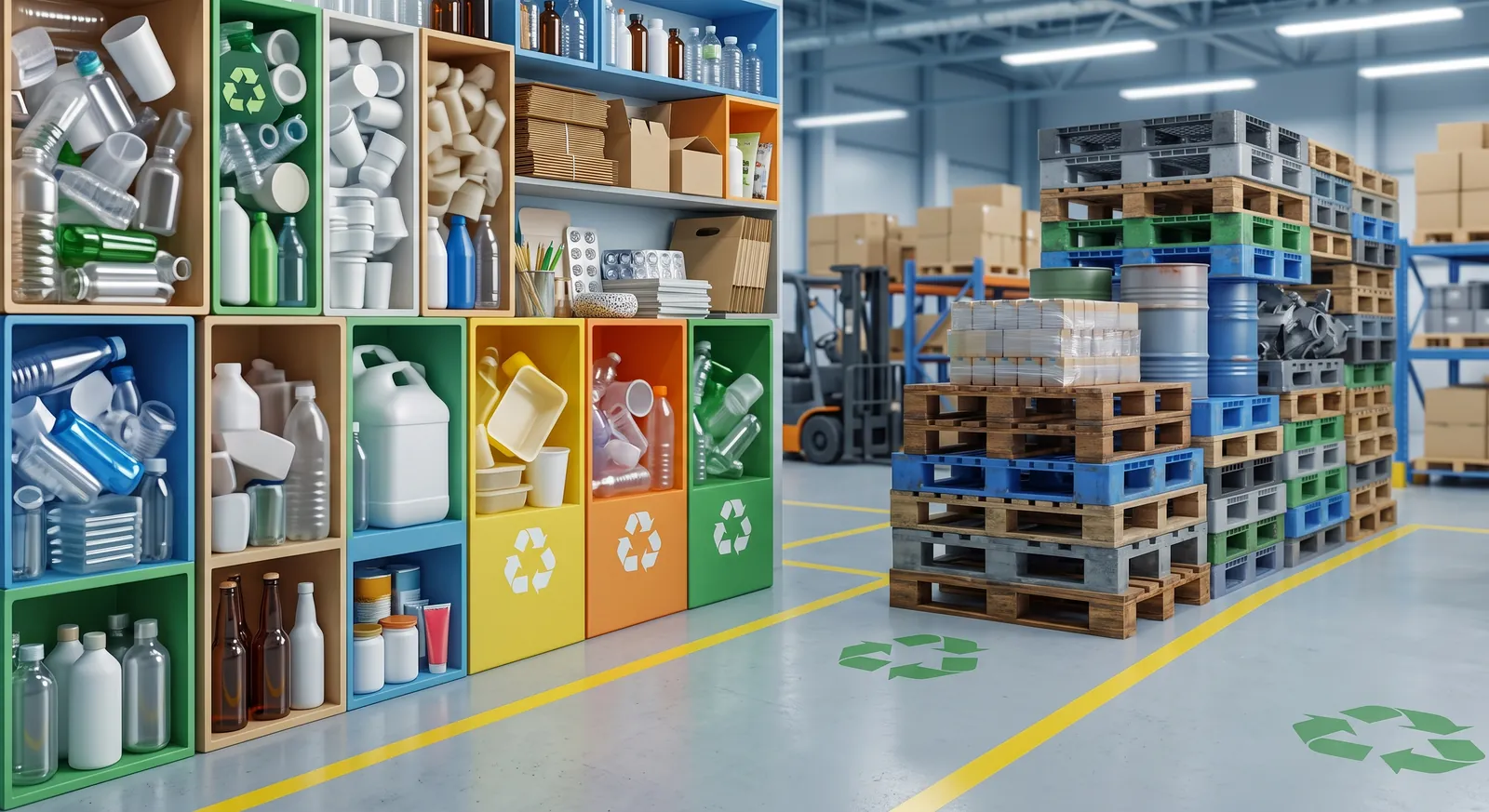

Meat, dairy, canned food, oils, sauces, snacks and frozen food use very similar packaging formats, and the PPWR regulates by material and by format, not by sector. The sector matters for one thing only: whether the packaging is in contact with food. That is why this guide goes by format: tray, film, bottle, carton, can, jar, multipack and transport packaging.
Short answer
- The Regulation applies from 12 August 2026 (Art. 71). Already enforceable: the sum of metals ≤ 100 mg/kg (Art. 5(4)), the PFAS limits for food-contact packaging (Art. 5(5)) and the declaration of conformity with its technical documentation (Arts. 15 and 39).
- Recycled content: only in plastic parts; minimum of 30 % (contact-sensitive PET and single-use plastic beverage bottles), 10 % (other contact-sensitive plastics) and 35 % (the rest) from 2030 or 3 years after the implementing act (Art. 7(1)).
- Recyclability: all packaging in grade A, B or C from 1/1/2030 or 24 months after the delegated acts; only A or B from 1/1/2038 (Art. 6(3)).
- Formats with their own rule: multipacks with film (banned from 2030, Annex V.1), air in sales packaging (Art. 24(4), from 2028), and pallets and transport film (re-use, Art. 29).
What each format requires
The requirements on substances, recyclability and declaration of conformity apply to all. The table shows, by format, what each adds.
| Format | Which articles weigh most | What to ask your supplier first |
|---|---|---|
| Plastic tray with film (meat, ready meals) | Recycled content of plastic parts (Art. 7); recyclability (Art. 6); PFAS and metals (Art. 5) | Tray and film material, % recycled per plant and year, and layer structure |
| Flexible multilayer pack (flow-pack, film bag: snacks, frozen food, bakery) | Recyclability (Art. 6) and recycled content (Art. 7); air in sales packaging (Art. 24(4)) | Composition per layer and weight of each; inks and adhesives; metals test |
| Plastic bottle (oils, sauces, some dairy) | Recycled content (Art. 7(1)): 30 % if contact-sensitive PET or a single-use beverage bottle; 10 % if another contact-sensitive plastic (see note below the table) | Resin, % recycled and composition of cap and label |
| Carton and multimaterial pack (dairy, broths, tomato) | Recyclability (Art. 6); recycled content of plastic parts, such as the cap (Art. 7); PFAS if there is a fluorinated barrier (Art. 5(5)) | Laminate composition, cap weight and fluorine proof for the barrier |
| Can and metal lid (canned food, fish) | Metals and PFAS in the inner coating (Art. 5); recyclability (Art. 6) | Metals and fluorine tests for the inner lacquer |
| Glass jar and bottle (canned food, sauces, oils) | Metals (Art. 5(4)); recyclability (Art. 6); plastic cap and label, under Art. 7 | Weight and material of cap, capsule and label |
| Multipack with film (packs of cans, jars, tubs) | Annex V.1 restriction from 1/1/2030 (Art. 25(1)), except grouping needed for handling | Whether the film is used for handling or to encourage buying more than one product |
| Box, pallet, film and strap for transport | 50 % maximum empty space (Art. 24(1)); 40 % reusable in transport (Art. 29(1)); 100 % reusable between sites and in deliveries to another operator in the same Member State (Art. 29(2)-(3)) | Which part of transport is paperboard or flexible film in direct contact with food, which are exempt (Art. 29(4)(c)-(d)) |
| Single-serve portions for catering (sauces, seasoning, sugar, coffee creamer) | Annex V.4: single-use plastic packaging with individual portions for HORECA is restricted, with exceptions (Art. 25(1)) | Whether you sell to catering and what material the portion is made of |
Note on bottles. «Single-use plastic beverage bottle» is defined in Part F of the Annex to Directive (EU) 2019/904: bottles of up to three litres, with exclusions. Industry sources treat milk as a beverage for that purpose, but this is not verified in the text: confirm it with the Commission guidance before fixing the percentage.
Which formats each sub-sector looks at
Indicative: these are the formats that predominate in each sub-sector. Check yours reference by reference, because the Regulation applies per packaging, not per company.
| Sub-sector | Usual formats | Recommended first focus |
|---|---|---|
| Meat and charcuterie | Thermoformed tray with film; multilayer vacuum; skin-pack | Recycled plastic in food contact and recyclability of the multilayer |
| Dairy | Bottle, tub, carton, cap | Recycled content of bottles and tubs; recyclability of the carton and lid |
| Canned food and fish | Can, jar, box and pallet film | PFAS and metals of the coating; pallet and film (Art. 29) |
| Oils, sauces and pantry | Plastic or glass bottle, jerrycan, bag-in-box, single-serve portions | Recycled content of bottles and caps; portions for catering (Annex V.4) |
| Snacks, ready meals, frozen food, bakery | Flow-pack and film bag; tray; cartons | Recyclability of multilayer flexible and air in sales packaging (Art. 24(4)) |
A useful rule for snacks and products that settle
From 12 February 2028, whoever fills sales packaging must reduce empty space to the minimum needed for functionality, including product protection (Art. 24(4)). For products that settle during transport or need a headspace to protect the food, compliance is assessed using the pack-fill level at the time of filling, and air between or within the food and protective gases do not count as empty space. If you pack in a protective atmosphere, document the fill level and the gas now.
Example: three references of a canning company
To see how the table is applied, these three fictitious references show what can be given today and what remains pending.
| Reference | Components | What applies from 12/08/2026 | What remains pending |
|---|---|---|---|
| Tuna in oil can | Steel body and lid, inner lacquer, paper label | Metals (Art. 5(4)); PFAS in the inner lacquer (Art. 5(5)); declaration of conformity and file | Recyclability (2030 or 24 months after the delegated acts); grouping film, if single-use plastic used to encourage buying more than one product (Annex V.1, 2030) |
| Tomato sauce jar | Glass, metal lid with plastic gasket, paper label | Metals (Art. 5(4)); declaration of conformity and file | Art. 7 for the plastic gasket, unless it weighs less than 5 % of the total weight of the packaging; recyclability |
| Smoked fish tray | Thermoformed PET tray, film and label | Metals and PFAS (Arts. 5(4)-(5)); declaration of conformity and file | 30 % recycled content if contact-sensitive PET (2030 or 3 years after the implementing act); recyclability; air in the pack (Art. 24(4), 2028) |
What to do in the next 30 days
- List of references with their format, material of each component and weight. It is the basis of the whole file.
- Mark those that touch food and ask your supplier for PFAS and metals proof (already enforceable).
- Identify multipacks with film and decide whether the film is needed for handling.
- Review your transport: how many pallets, boxes and films you use and which are exempt under Art. 29(4).
- Prepare the declaration of conformity per packaging type and the technical file (Annex VIII model).
In Spain, in addition: manufacturer, producer and register
The PPWR distinguishes two roles that usually coincide in a packing company. The manufacturer answers for the design and conformity of the packaging: it assesses, documents and signs. The producer is whoever first makes the packaging or the packaged product available in a Member State and takes on extended producer responsibility: registering in the producer register, reporting what it places on the market and financing the management of its waste (Art. 44). According to the Packaging Cluster of Valencia (05/08/2026), manufacturer and producer can be different companies, and according to Ecoembes (13/07/2026), a packer that sells under its own brand in Spain holds both roles.
These obligations add to those of Royal Decree 1055/2022; they do not replace it. On 27 July 2026 the Ministry for the Ecological Transition (MITECO) published an interpretative note on who is a producer and who must register in the packaging section of the Product Producers Register, which distinguishes between producers of packaged products and of transport, service or primary-production packaging (according to the Packaging Cluster; the note itself could not be consulted directly). Joining a collective extended-responsibility scheme organises those obligations but does not replace the producer's legal responsibility.
What is not settled yet
| Act | Legal deadline | What changes |
|---|---|---|
| Methodology for calculating recycled content (Art. 7(8)) | 31/12/2026 | How the percentage is demonstrated and in what format |
| Recyclability criteria and grades (Art. 6(4)) | 1/1/2028 | When you will know which grade each format falls into |
| Empty-space methodology (Art. 24(2)) | 12/02/2028 | How the 50 % in transport is measured |
| Commission guidelines on Annex V (Art. 25(6)) | 12/02/2027 | Examples of formats covered and exemptions |
| Harmonised label (Art. 12(6)) | 12/08/2026 | Material pictograms for the consumer |
Check on EUR-Lex which of these are already published. At the end of September 2026, FoodNavigator (28/08/2026) and PPWR Connect (September 2026) reported that the harmonised label of Art. 12(6), with a legal deadline of 12/08/2026, had not yet been adopted and that adoption was expected in the fourth quarter. These are secondary industry sources and have not been confirmed on EUR-Lex. For the full calendar, see the PPWR obligations calendar.
The Commission has also published a guidance document on the Regulation (June 2026) and frequently asked questions (July 2026), as reported by the Packaging Cluster of Valencia (05/08/2026). This article is based on the text of the Regulation and does not cover those documents in full: consult them for doubtful cases.
If you have dozens of references
Retexcycle's free PPWR assessment determines your role and the obligations that apply to you; the PPWR Compliance Hub generates the dossier for each packaging and tells you what is missing.
Frequently asked questions
Do I already have to use recycled plastic in my food packaging?
Not yet. The minimum recycled content in plastic parts applies from 1 January 2030 or 3 years after the implementing act of Art. 7(8) enters into force, whichever is later (Art. 7(1)). That act must be adopted before 31 December 2026.
What recycled percentage applies to me?
In 2030: 30 % for contact-sensitive packaging with PET as the main component, and 10 % for other plastics, except single-use plastic beverage bottles (30 %); 35 % for all other plastics. In 2040: 50 % (contact-sensitive PET), 25 % (other contact-sensitive plastics), 65 % (single-use plastic beverage bottles) and 65 % (the rest) (Art. 7(1) and (2)).
Does recycled content apply to cans, glass jars and paperboard boxes?
Not directly: Art. 7 refers to plastic parts. If the packaging has a plastic part, such as a cap, a lid or a lamination, that part is covered, unless it weighs less than 5 % of the total weight of the packaging (Art. 7(5)(b)).
From when do the PFAS limits apply?
From 12 August 2026 for food-contact packaging (Art. 5(5)): 25 ppb for each PFAS, 250 ppb for the sum and 50 ppm in total. It must be demonstrated in the technical documentation (Art. 5(6)).
Who signs the declaration of conformity if I pack under contract for a brand?
Whoever puts its name or trademark on the packaging or on the packaged product is the manufacturer, even if another company makes it (Art. 3(1)(13)(a)). We cover it in our article on the EU declaration of conformity.
Are multipacks with plastic film banned?
Annex V bans from 1 January 2030 single-use plastic packaging that groups, at the point of sale, products sold in bottles, cans, tins, pots, tubs and packets, when designed as convenience packaging to encourage buying more than one product. Grouping needed to facilitate handling is excluded (Annex V, point 1; Art. 25(1)).
Does an oil or milk bottle count as a «beverage bottle»?
Art. 7 refers to single-use plastic beverage bottles in Part F of the Annex to Directive (EU) 2019/904: bottles of up to three litres, with their caps and lids and with exclusions. Industry sources treat milk as a beverage for that purpose, but this is not verified in the text: confirm it with the Commission guidance before fixing the percentage.
What about fresh fruit and salads?
Fresh fruit and vegetables pre-packed in less than 1.5 kg have their own restriction on single-use plastic packaging in Annex V, point 2, with exceptions that Member States may set. That restriction is not covered here.
Keep reading
- PPWR for packaging manufacturers: what data to give your customer
- PPWR EU declaration of conformity: model, content and technical file
- Private label and the PPWR: what to ask your packaging supplier
- PPWR 2026: what the Packaging Regulation requires from 12 August
Verified on 5 November 2026 against the official English text of Regulation (EU) 2025/40 (Arts. 3, 5, 6, 7, 12, 15, 24, 25, 29, 39, 44 and 71 and Annex V). General information, not legal advice. The recommendations in this article are Retexcycle working proposals, not text of the Regulation. Source: Regulation (EU) 2025/40.