
Since 12 August 2026, every packaging placed on the EU market needs an EU declaration of conformity and a technical file to back it up. The manufacturer prepares both, without a notified body, and there is an official model in Regulation (EU) 2025/40 (PPWR). This article explains what each contains, who signs them and how to fill in the Annex VIII model.
Short answer
- The EU declaration of conformity states that compliance with Articles 5 to 12 of the PPWR has been demonstrated. It follows the Annex VIII model and is kept continuously up to date (Art. 39).
- It rests on an Annex VII technical file (module A, internal production control), with no notified body.
- There is one per packaging type, and it is kept with the file for 5 years (single-use packaging) or 10 years (reusable) (Art. 15(3)).
- It is signed by the legal manufacturer, that is, whoever puts their name or brand on the packaging. The contract allocates tasks, not responsibility (Art. 39(4)).
What is the EU declaration of conformity and who signs it?
Before placing a packaging on the market, the manufacturer carries out the conformity assessment and draws up the technical documentation (Art. 15(2) and Art. 38). Once it has been shown that the packaging complies, the manufacturer draws up the EU declaration (Art. 39). By signing it, the manufacturer assumes responsibility for the packaging complying with the Regulation (Art. 39(4)).
The manufacturer is whoever puts their name, brand or design on the packaging, even if another company produces it (Art. 3(1)(13)). If you buy plain bags and put your logo on them, or you outsource packing to a contract packer, the signature is yours. There is an exception for micro-enterprises: if the one who orders the packaging with its brand is a micro-enterprise and its supplier is established in the EU, the supplier is considered the manufacturer (Art. 15(12)).
| Your situation | Who signs |
|---|---|
| You manufacture or pack under your brand | You, even if someone else produces the packaging |
| You pack under contract for another brand | Whoever puts their name or brand; the contract allocates tasks, not responsibility (Art. 39(4)) |
| You import the product already packed | The one at origin is the manufacturer; you, as importer, check their documentation and can ask them for the declaration (Art. 18) |
| You are a micro-enterprise and order the packaging under your brand from an EU supplier | The supplier, who is considered the manufacturer (Art. 15(12)) |
The official model: Annex VIII, point by point
The declaration follows the Annex VIII model. This table shows each point and what to put; the examples are illustrative and refer to a coffee bag.
| Annex VIII point | What is declared | Illustrative example |
|---|---|---|
| Declaration number | Identifier of the declaration itself | DC-2026-014 |
| 1. Unique identification of the packaging | Type, batch or serial number that allows it to be identified | Roasted coffee bag 250 g, ref. BT-250 |
| 2. Manufacturer and, where applicable, authorised representative | Name and address | Company name, postal address and, if there is one, representative |
| 3. Responsibility | Fixed sentence: issued under the sole responsibility of the manufacturer | Text of the model, unchanged |
| 4. Object of the declaration | Description of the packaging allowing its traceability | Multilayer bag with valve, dimensions and materials |
| 5. Union legislation applied | The other Union acts with which it complies | For example, where applicable, Regulation (EC) No 1935/2004 on food contact materials |
| 6. Standards and specifications | Harmonised standards, common specifications or other technical specifications used | Test methods applied to PFAS and metals |
| 7. Notified body | Only if one is involved | Normally "not applicable" under module A |
| 8. Additional information | Whatever the manufacturer adds | Reference to the technical file |
| Signature | Place and date of issue; name and position; signature | Person authorised by the company |
If the packaging is subject to more than one Union act requiring a declaration of conformity, a single declaration is drawn up citing all of them (Art. 39(3)). It is available in the official text of Regulation (EU) 2025/40.
Full example: roasted coffee bag
This is how the declaration would look filled in with fictitious data. It shows the level of detail expected, not text to copy.
EU declaration of conformity No DC-2026-014
- Packaging: 250 g roasted coffee bag, ref. BT-250, batch on the bag seal.
- Manufacturer: Tostadores Ejemplo, S.L., street and city. No authorised representative.
- This declaration of conformity is issued under the sole responsibility of the manufacturer.
- Object: multilayer bag with degassing valve, components and materials as per data sheet FC-BT-250 v2; intended use: packaging of roasted whole-bean or ground coffee.
- Union legislation: Regulation (EU) 2025/40 and, where applicable, Regulation (EC) No 1935/2004 on food contact materials.
- Standards and specifications: test methods applied to heavy metals and PFAS set out in technical file ET-BT-250.
- Notified body: not applicable.
- Additional information: technical file ET-BT-250, version 2; last reassessment on 10 September 2026.
Signed in Madrid on 10 September 2026 by the operations director.
The Annex VII technical file (module A)
The technical documentation must make it possible to assess whether the packaging meets the requirements and must include an adequate analysis of the risks of non-conformity. As a minimum, where applicable, it contains:
- A general description of the packaging and its intended use.
- The design drawings and manufacturing drawings, and the materials of each component.
- The descriptions and explanations needed to understand those drawings and how the packaging works.
- The list of harmonised standards, common specifications and other technical specifications applied, and, where they are not applied, the solutions adopted to comply.
- A qualitative description of how the assessments provided for in Articles 6, 10 and 11 were carried out.
- The test reports.
The manufacturer must also take the measures necessary for the manufacturing process to keep the packaging in conformity with that file (Annex VII, point 3). The file and the declaration are handed to the authority that requests them, in a language it understands and within ten days (Art. 15(10)).
What to ask your supplier so that the file holds up
The file is built from third-party documents. These are the first ones worth requesting:
| Document | Issued by | What it is for |
|---|---|---|
| Declaration of substances of concern from each supplier (Art. 5(1) and 5(6)) | Packaging or material supplier | Shows compliance with the substance limits of Article 5 |
| Heavy metals test report: sum of lead, cadmium, mercury and hexavalent chromium below 100 mg/kg (Art. 5(4)) | Laboratory | Proves the metals limit |
| PFAS tests on food-contact packaging (Art. 5(5)) | Laboratory | Proves the PFAS limits: 25 ppb for each, 250 ppb for the sum and 50 ppm for the total |
| Weight and volume minimisation assessment (Art. 10) | Manufacturer | Part of the assessments covered by Annex VII |
| Evidence of recyclability or compostability where applicable (Arts. 6 and 9) | Supplier or laboratory | Supports the assessment cited in Annex VII, point 2(e) |
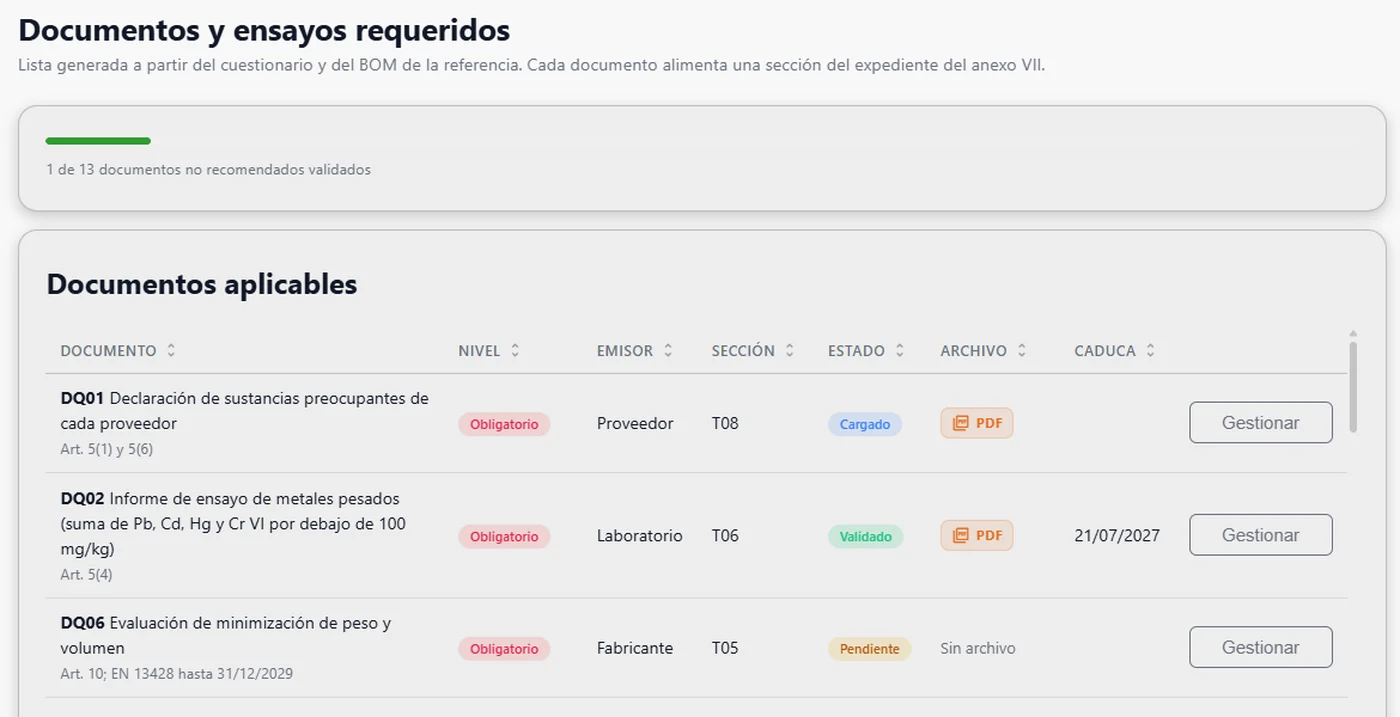
Each document feeds a section of the file, and tests have an expiry date: it is worth knowing when they must be renewed. In the Retexcycle Compliance Hub PPWR this list is generated from the questionnaire and the component list of each reference, with who issues each document and when it expires.
Deadlines, identification and reassessment
- Retention: 5 years from placing single-use packaging on the market; 10 years for reusable packaging (Art. 15(3)).
- Identification on the packaging: type, batch or serial number, and the name or brand and postal address of the manufacturer, on the packaging, in a QR code or in an accompanying document (Art. 15(5)-(6)).
- Reassessment: if the design, the characteristics or the applied standards change and conformity may be affected, the manufacturer assesses again (Art. 15(4)).
- Correction: if a packaging does not comply, the manufacturer corrects it, withdraws it or recalls it immediately and informs the authority (Art. 15(8)).
- Control: authorities seek to check each year the accuracy of a share of the declarations, with a risk-based approach (Art. 39(5)).
Checklist before signing
- I have the list of packaging components with the weight and material of each.
- I have the declaration of substances of concern from each supplier and the metals and PFAS tests where applicable.
- I have the recyclability and weight and volume minimisation assessment that applies.
- The packaging carries the type, batch or serial number and the manufacturer's name or brand and postal address, on the packaging, in a QR code or in an accompanying document (Art. 15(5)-(6)).
- The declaration has its own identifier and is signed by an authorised person.
- It is drafted, or translated, in the language required by the Member State (Art. 39(2)).
- I have noted how long to keep it: 5 years (single use) or 10 years (reusable) from placing on the market.
Common mistakes when preparing the declaration
- A single declaration for all packaging. There must be one per packaging type, with its identification.
- Copying the model without evidence. The declaration rests on the file: drawings, materials and tests.
- Taking the supplier's declaration at face value. If the packaging carries your brand, the responsibility is yours: ask for the PFAS and metals tests and the materials information.
- Not identifying the packaging. The type, batch or serial number, or the manufacturer's details, are missing.
- Not updating. A change of material, ink or supplier may require reassessment.
Where to start
- Inventory of formats, with the weight and material of each component. In the Retexcycle Compliance Hub PPWR you register each reference with its components.
- Role per reference: does it carry your brand? That decides who signs. The Retexcycle questionnaire deduces your role and each question cites its article.
- Supplier documents: PFAS and metals tests, material declarations and recyclability or compostability evidence.
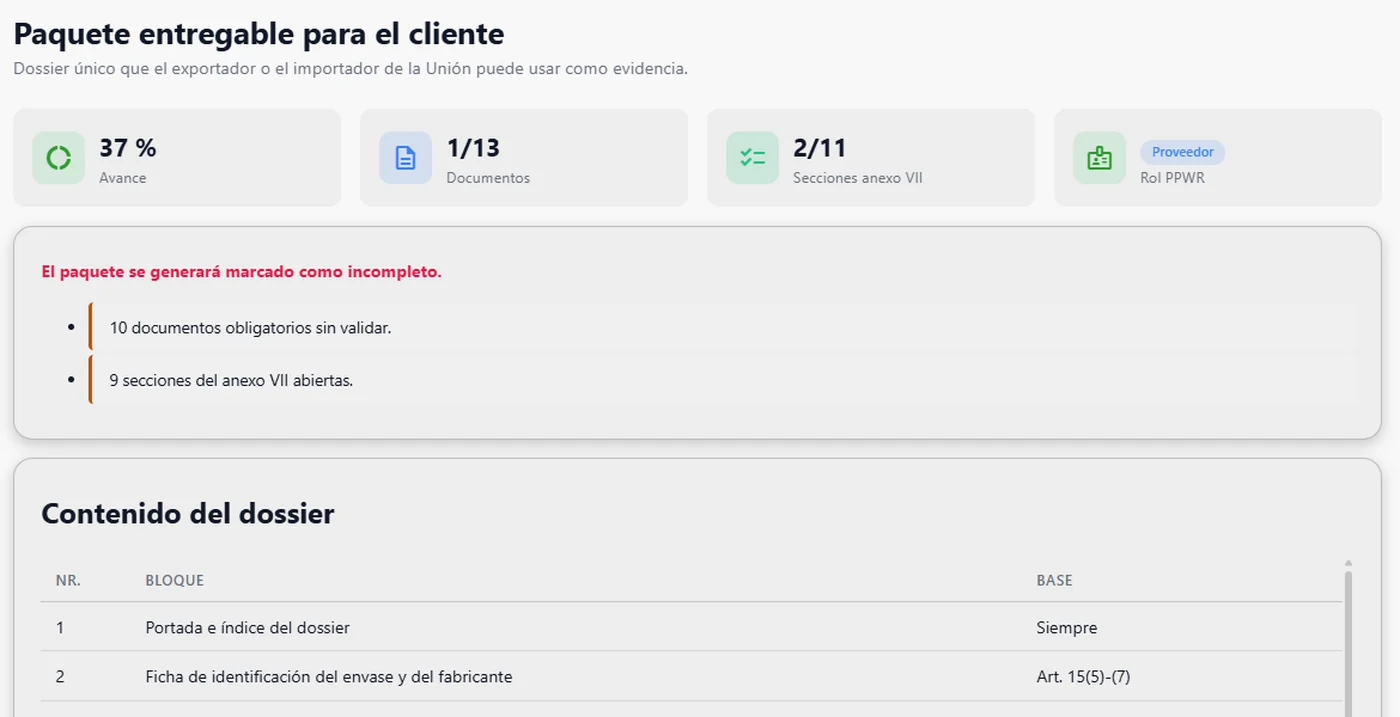
- File and EU declaration per packaging type. Retexcycle generates the package with templates for the EU declaration, the technical file and the representative's mandate; if anything is missing, it comes out marked as incomplete.
Retexcycle Compliance Hub PPWR
Want your declaration and your file for each packaging?
Prepare the technical file and the EU declaration for each reference with templates, and export the package for your customer or importer.
Frequently asked questions about the PPWR declaration of conformity
What is the PPWR EU declaration of conformity?
It is the document by which the manufacturer states, under its sole responsibility, that it has demonstrated that the packaging meets the requirements of Articles 5 to 12 of Regulation (EU) 2025/40 (Art. 39(1) and Annex VIII).
Who has to sign it?
The legal manufacturer: whoever puts their name, brand or design on the packaging, whether they make it or a third party does (Art. 3(1)(13)). The contract can allocate tasks, but not responsibility (Art. 39(4)). If the manufacturer is a micro-enterprise and its supplier is in the EU, the supplier is considered the manufacturer for this purpose (Art. 15(12)).
Is there an official PPWR declaration of conformity model?
Yes. Annex VIII of the Regulation sets the model, with eight points: unique identification of the packaging, manufacturer details, sole responsibility, description of the packaging, Union legislation applied, standards or specifications used, notified body if any and additional information, plus place, date, name, position and signature.
Is a notified body needed?
No. The procedure is module A of Annex VII, internal production control: the manufacturer draws up the technical documentation and declares conformity under its own responsibility, with no third-party involvement.
How long must the declaration and the technical file be kept?
Five years from placing single-use packaging on the market and ten years for reusable packaging (Art. 15(3)).
One declaration per product or per packaging?
One per packaging type (Annex VII, point 4). Variants that change the design or the characteristics, such as a different material or design, require reassessment if conformity may be affected (Art. 15(4)).
In what language must the declaration be?
In the language or languages required by the Member State on whose market the packaging is placed or made available, or translated into them (Art. 39(2)). And it must be kept continuously up to date.
Verified against the official text of Regulation (EU) 2025/40 (Articles 15, 38 and 39, and Annexes VII and VIII) in October 2026. The examples in the table are illustrative. Informational summary, not legal advice. Source: Regulation (EU) 2025/40.