
If you manufacture, buy or import cardboard boxes, paper bags, pallets or wooden crates, the question is not whether «cardboard falls under the EUDR». The answer depends on how the packaging reaches the market: as a product in its own right or as packaging for another product. Since 18 September 2026, Annex I says so in writing. This article goes through the cases using the legal text and the Commission's criteria, and ends with what to ask your supplier.
Short answer
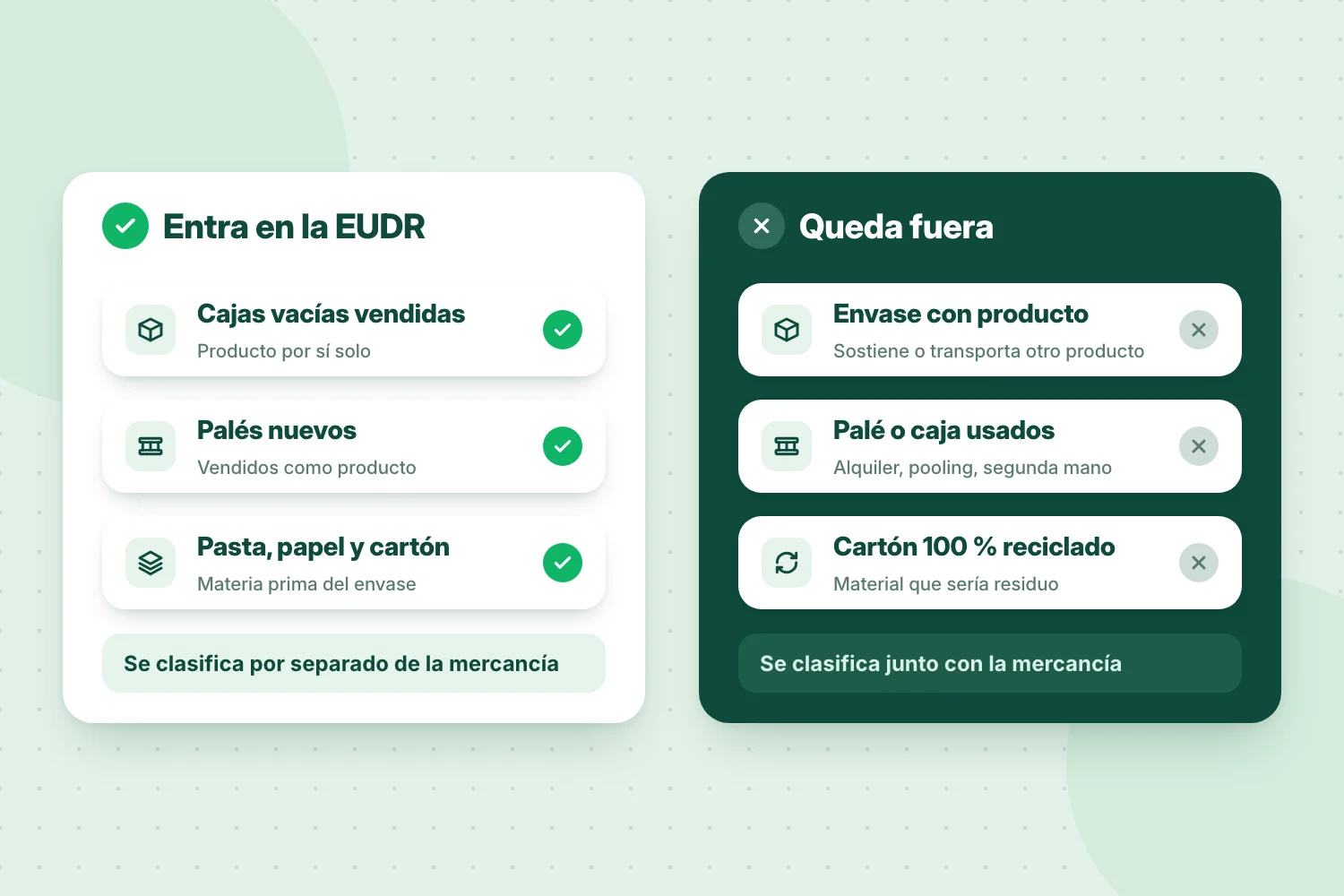
- A wood, paper or cardboard package that is sold or imported as a product in its own right (empty boxes, new pallets) is a relevant product under Annex I.
- If it is used to support, protect or carry another product, it is out of scope, whatever its customs code.
- Used or second-hand packaging and pallets, and paper and cardboard made entirely from recycled material that would have been waste, are also out.
- The raw material of the packaging is not out: pulp, paper and cardboard sold as such, and sawn wood for making pallets.
- It applies from 30 December 2026. The Commission's interpretation is in working FAQs, which are not binding.
The rule, in one sentence
Annex I excludes, from several headings, packaging materials and packaging used exclusively to support, protect or carry another product placed on the market or exported and presented with it. There are two versions of the exception:
- Single-use packaging, in headings 4401, 4405, 4415 and 4416 (wood) and in chapter 48 (paper and cardboard).
- Packaging clearly suitable for repeated use (for example, a pallet that is reused), in headings 4415 and 4416 and in chapter 48. It is out of scope from the moment it is used for that purpose.
Delegated Regulation (EU) 2026/2102, of 13 July 2026, published on 17 September and in force from the following day, put this wording into Annex I. Its recital 16 sums up the logic: packaging placed on the market or exported as products in their own right falls within the scope of the Regulation, and does not when used to support, protect or carry another product. Wood pulp (chapter 47) does not have this packaging exception.
How to tell whether packaging is a «product in its own right»
The Commission explains it in its frequently asked questions (v5, April 2026, question 2.5). What decides is not the customs code or whether the packaging appears on the invoice next to the product. What decides is how it would be classified in an import or export under rule 5(b) of the general rules for the interpretation of the Combined Nomenclature: packaging presented with the goods and of a kind normally used for such goods is classified with them.
- If the packaging is classified together with the goods, it is considered packaging of another product: out of scope.
- If it is classified separately (empty boxes or new pallets sold or imported as such), it is a product in its own right: in scope.
The most common cases
| Case | In scope? | Why |
|---|---|---|
| Cardboard box or pallet carrying a product (yours or a customer's) | No | Used to support, protect or carry another product (Annex I; FAQ 2.5) |
| Boxes, bags or pallets new and sold empty by a manufacturer | Yes | Product in its own right (FAQ 2.5; recital 16) |
| Empty packaging imported from outside the EU | Yes | First placing on the market in the EU: the importer is the operator (Art. 2) |
| Pallet or box that is used, rented or in a pooling system | No | Used and second-hand products (Annex I; FAQ 2.6) |
| Used pallet repaired with new wood and sold | Only the new wood | The EUDR applies to the new components (FAQ 2.6) |
| Paper or cardboard made only from recycled material that would have been waste | No | Annex I; FAQ 2.8 |
| Paper or cardboard with virgin fibre or with manufacturing by-products | Yes, the non-recycled part | It must be traced back to the plot (FAQ 2.8) |
| Pulp, paper and cardboard sold as raw material; sawn wood for pallets | Yes | Chapters 47 and 48 and heading 4407; they are not packaging for another product |
| Labels and leaflets sold as products in their own right | Generally yes | Annex I chapter 48; recital 17 |
| Labels or leaflets that accompany another product or are given free for commercial or information purposes | No | Annex I chapter 48; recital 17 |
| Packaging made of bamboo, rattan or other woody materials | No | Note 4 to Annex I |
| Samples of insignificant value and quantity, usable only for placing orders | No | Note 5 to Annex I |
The Regulation's definitions (Art. 2) do not state what «used» or «second-hand» means. If you sell or rent used packaging, keep proof of first use: the delivery note of the first delivery with product or the pooling system record.
What applies to you if the packaging is in scope
- You are an operator (you import empty packaging or place wood or paper on the market for the first time): you submit the DDS before placing them on the market or exporting them, with the country of production, the geolocation of the plots where the wood grew and the scientific name of the species. The latter is mandatory for all wood products, including pulp and paper (FAQ 7.27). The details are in the due diligence statement (DDS).
- You are a downstream operator or trader (you process or resell product that already has a DDS): you do not submit a DDS. You collect and keep for five years the data of your suppliers and customers and the DDS reference numbers when your supplier is an operator (Art. 5). If you are not an SME, you must also register in the information system. To know which role you play, see Who is the operator under the EUDR.
- Mass balance is not allowed: material of known origin cannot be mixed at any step with material of unknown origin or not deforestation-free (FAQ 1.4). If it is mixed and cannot be separated, the whole batch is non-compliant (FAQ 1.5).
- Certificates help, they do not replace: they serve to assess risk if they cover the required information, but the operator remains responsible (FAQ 5.7).
Fictional example: a box factory
An invented packaging factory in Valencia converts corrugated board into boxes and also sells pallets. It buys the board from an EU paper mill.
- It sells empty boxes to a canning company. They are a product in their own right. If all the board it uses is already covered by the paper mill's DDS, it is a downstream operator: it keeps the data and references of its supplier and its customer.
- It imports printed folding boxes from outside the EU. It is the operator of those boxes: DDS before clearing them, with the fibre plots provided by its supplier.
- It delivers the boxes on its own pallets, which it later collects. If the pallet only accompanies the goods, it is out of scope. New pallets it sells as a product are in scope.
- It buys used pallets and resells them repaired. Only the new wood used in the repair is covered (FAQ 2.6).
What to ask your packaging supplier
If you are a brand or manufacturer that buys packaging, the EUDR does not oblige you regarding the packaging you use to hold your product. It is still worth knowing what is behind it, because your supplier will have to prove it, and because if you resell empty packaging or new pallets you become a trader. Ask in writing for:
- Which part of what it sells you is a product in its own right and which part accompanies goods.
- Its role in each flow (operator, downstream operator or trader) and the customs code of each packaging.
- For paper and cardboard, what percentage is recycled fibre and what part is virgin or by-product.
- For imported packaging, who the importer is and who submits the DDS.
- What type of chain of custody covers each batch and whether material of unknown origin is mixed in.
- For pallets, whether they are new, used, repaired with new wood or pooled.
Ask for it in the same round in which you request the PPWR data. The PPWR requires material and composition data, and the EUDR adds the origin of the fibre or wood. The article PPWR for packaging manufacturers: what data to give your customer covers the Packaging Regulation side.
From when and with what risk
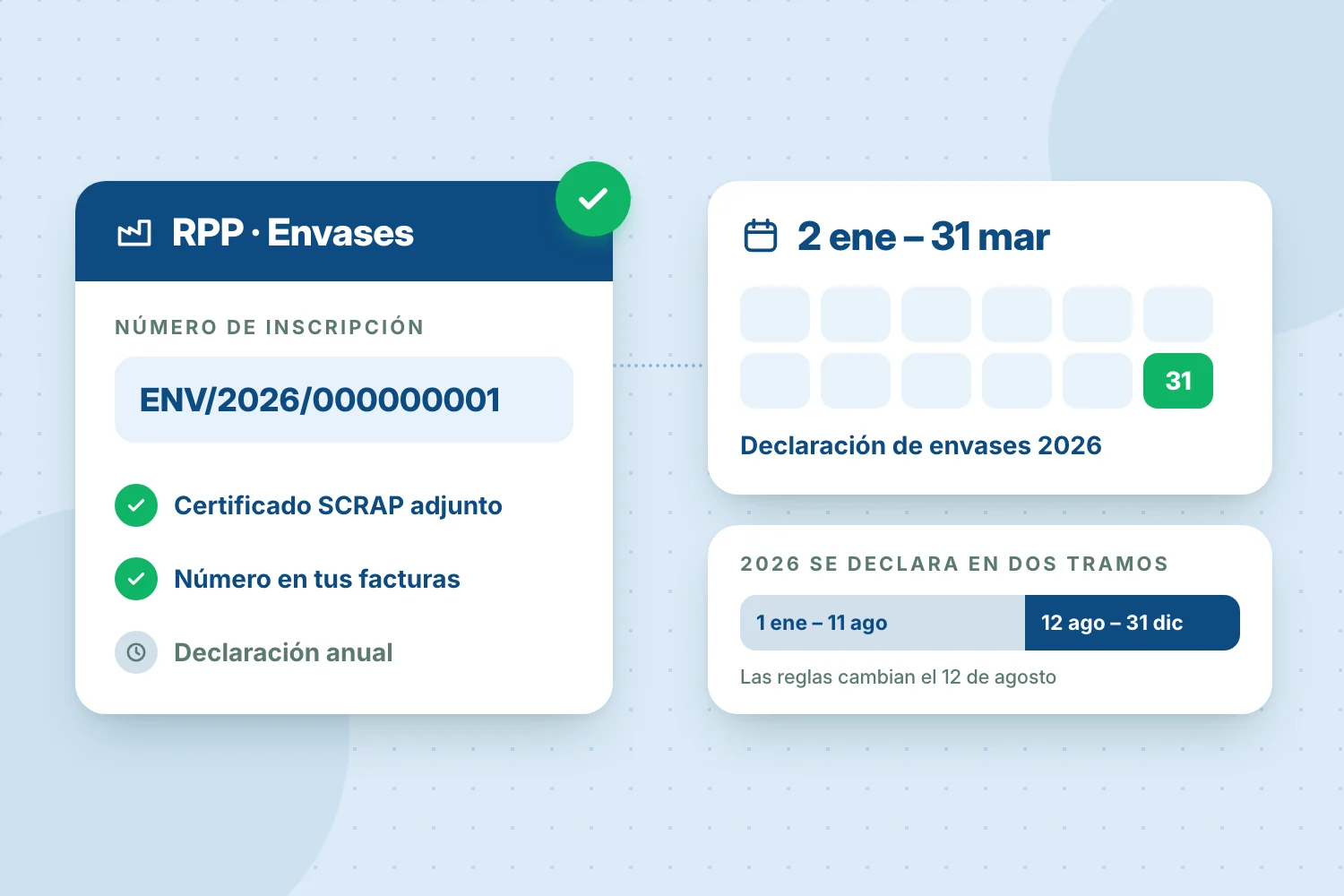
The due diligence articles apply from 30 December 2026. Operators that are natural persons, micro or small enterprises, established as such on 31 December 2024, have until 30 June 2027, except for the products in the annex to Regulation (EU) 995/2010 (Art. 38). If you do not comply, you face unannounced inspections and penalties: this is explained in EUDR: what inspections and penalties can reach you.
Six checks before 30 December
- List the customs codes of your packaging and raw materials (4415, 4416, chapters 47 and 48, sawn wood).
- For each flow, note whether the packaging is sold or imported empty or goes with product.
- Identify your role in each flow: operator, downstream operator or trader.
- Ask suppliers for the six items of information above and file their answers.
- Separate new, used and repaired pallets, and keep proof of first use.
- Review contracts: include the obligation to provide origin data and DDS references.
How Retexcycle helps
Retexcycle's Compliance Hub gathers your suppliers' origin data and generates the DDS with plot geolocation. In addition, on 2 December 2026, from 10:00 to 11:00, Retexcycle explains the EUDR at the Packaging Cluster webinar: Envasos lliures de desforestació: claus de l’EUDR.
Frequently asked questions
Are pallets and cardboard boxes covered by the EUDR?
It depends on how they reach the market. If they are sold or imported as a product in their own right (for example, empty boxes or new pallets), they are relevant products under Annex I. If they are used to support, protect or carry another product, they are out of scope, regardless of the customs code under which they are classified (Commission FAQ, v5, question 2.5).
What about used, rented or pooled pallets?
They are out of scope. Annex I excludes used and second-hand products in headings 4415 and 4416, and the Commission states that selling or renting used packaging is not subject to the EUDR, including packaging that entered the EU carrying goods and is sold afterwards (FAQ 2.6). If a used pallet is repaired with new wood, only the new wood is covered.
Are recycled paper and cardboard in scope?
Products made entirely from material that has reached the end of its life and would be waste are not covered. If they contain non-recycled material, such as virgin fibre or by-products of a manufacturing process, the non-recycled part is covered and must be traced back to the plot (Annex I and FAQ 2.8).
And labels, leaflets and marketing material?
Sold or placed on the market as products in their own right, they are generally covered. They are not covered if they accompany another product or are supplied free of charge for commercial or information purposes; neither are items of correspondence (Annex I chapter 48 and recitals 17 and 18 of Delegated Regulation (EU) 2026/2102).
I buy empty boxes from a manufacturer outside the EU: who is the operator?
If the empty packaging enters the EU as a product in its own right, whoever places it on the market is the operator (Art. 2) and must submit the DDS before release. In practice, that is whoever appears as the importer on the customs declaration: it may be you or your supplier. Clarify it in writing with them and with your customs agent before the first delivery.
Does a forest management certificate help me?
It helps, but it does not replace due diligence. According to the Commission, certification schemes can be used in risk assessment to the extent that they cover the information the Regulation requires, and the operator remains responsible (FAQ 5.7). Also, mass balance chains of custody, which mix material of known origin with material of unknown origin, are not allowed (FAQ 1.4). Ask what type of chain of custody covers each batch.
Is the weight of the packaging included in the net mass of the DDS?
No. Net mass is the weight of the product itself, without the container, wrapping or other packaging materials used for transport or storage (FAQ 7.22).
From when does it apply to packaging?
From 30 December 2026 for obliged companies (Art. 38(2)). Operators that are natural persons, micro or small enterprises, established as such on 31 December 2024, have until 30 June 2027, except for the products in the annex to Regulation (EU) 995/2010 (Art. 38(3)). If your products may be in that annex, check before counting on the extension.
Verified on 19/11/2026 against the consolidated text of Regulation (EU) 2023/1115 on EUR-Lex (18/09/2026), Delegated Regulation (EU) 2026/2102 and the Commission's frequently asked questions (v5, April 2026, non-binding working document). Informational summary, not legal advice: the customs classification of each packaging and the role that applies to you depend on your case. Sources: Regulation (EU) 2023/1115; Delegated Regulation (EU) 2026/2102; Commission FAQ on the EUDR.