
On 30 December 2026 the EUDR starts to apply to large and medium-sized companies. From that day, the authorities must check a minimum percentage of companies every year, normally without warning, and Member States must have penalties that reach at least 4 % of annual EU turnover. This article explains who is checked, what is reviewed, what happens if something fails and what you can prepare before 30 December.
Short answer
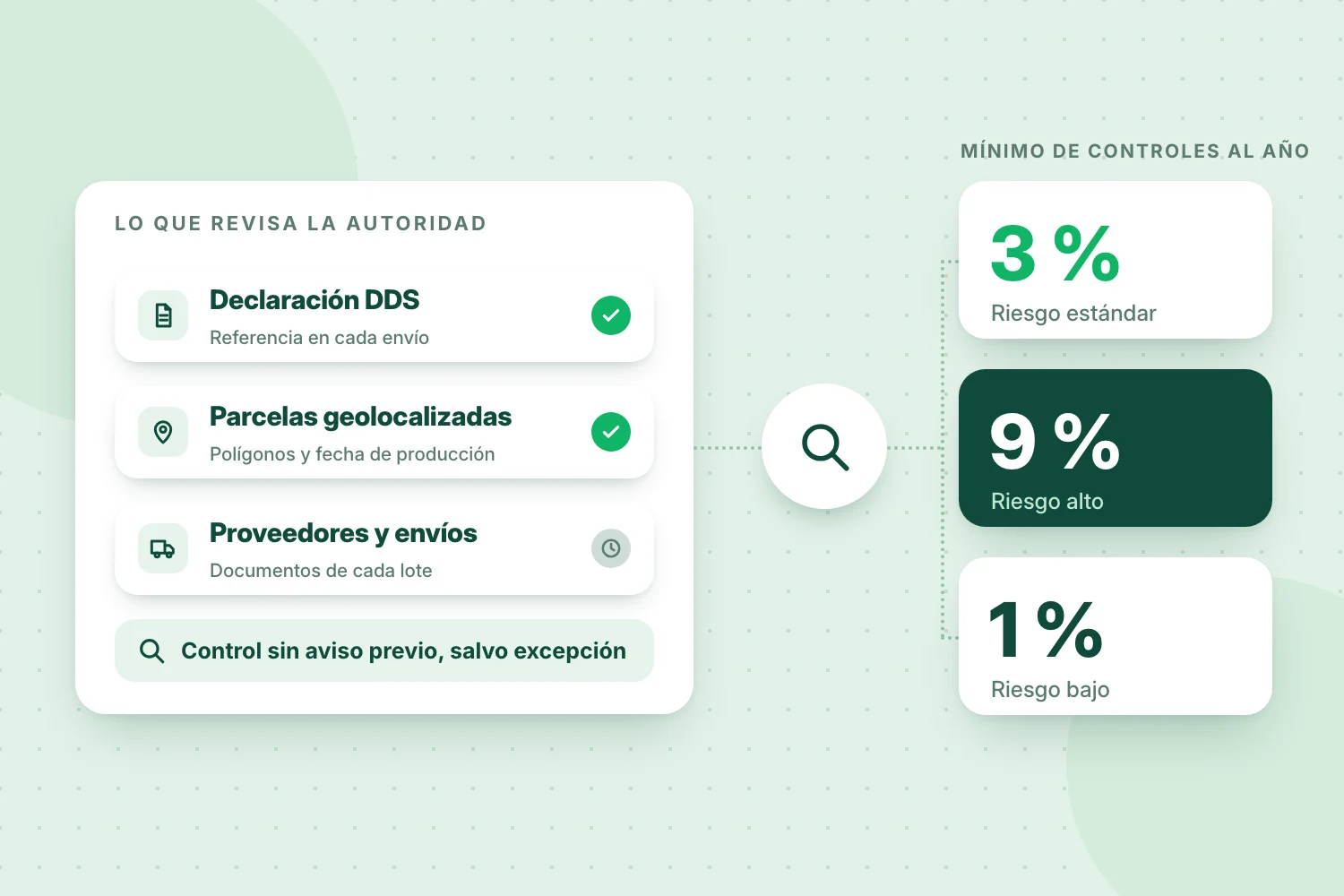
- Every year, per commodity, at least 3 % of obliged companies are checked if the origin is standard risk, 9 % if it is high risk and 1 % if it is low risk (Art. 16).
- Checks are carried out without prior notice, unless notification is necessary for them to be effective, and customs clearance does not prove that you comply (Arts. 16(13) and 26(10)).
- The authority reviews your due diligence system and the documentation for each shipment, and may request technical evidence such as satellite data or DNA analysis (Art. 18).
- Penalties (Art. 25) include fines with a maximum of at least 4 % of annual EU turnover, confiscation and exclusion from public procurement for up to 12 months.
- In Spain, the law with the specific fines has not yet been passed: it is a draft bill from June 2025.
Who inspects you in Spain
According to MITECO, the national authority is the Directorate-General for Biodiversity, Forests and Desertification, and each autonomous community has designated its own. At the border, customs authorities intervene and check that the due diligence statement (DDS) reference number is available before release (Art. 26(4)). Passing customs does not protect you: release is not considered proof of compliance (Art. 26(10)).
Who is checked and how often
The authority applies a risk-based approach and prepares annual control plans. The legal minimum is measured per commodity and according to the risk classification of the country of origin (Art. 16(8) to (11), Art. 29):
| Risk of the country of origin | Annual minimum of checks |
|---|---|
| High | 9 % of companies and 9 % of the quantity of product |
| Standard | 3 % of companies |
| Low | 1 % of companies |
Operators of any size count, as do downstream operators and traders that are not SMEs. To choose whom to check, the authority takes into account, among other factors, the commodity, the length and complexity of the chain, whether the plots are adjacent to forests, the country risk, the history of non-compliance and the risks of circumvention (Art. 16(3)). It may even specify which DDS it is going to review (Art. 16(5)(b)). And it may check outside the plan if it receives information about possible non-compliance (Art. 16(12)).
A third party can also trigger an inspection
Any person or entity can submit a «substantiated concern» to the authority (Art. 31). The authority must assess it without delay, may carry out checks and hearings, and must inform the complainant within 30 days, unless national law says otherwise. The identity of the person who submits it must be protected. For a company, this means the supply chain must be justifiable even if it is not selected in the annual plan.
What is reviewed in an inspection
| If you are… | The inspection includes | And if there are doubts, it may add |
|---|---|---|
| Operator (Art. 18) | Your due diligence system, with its risk assessment and mitigation procedures, and the documentation and records that demonstrate it. Also the documentation for each product and its DDS (or the simplified declaration of a micro or small primary operator). | On-site analysis of the commodity, DNA or chemical analysis, Earth observation data (such as Copernicus), random checks and field audits, also in third countries if they agree |
| Downstream operator or trader (Art. 19) | The documentation and records showing that you meet the obligations of Art. 5(1) to (4) (collecting and keeping information on suppliers and customers) | Random checks, including field audits |
Operators must review their due diligence system at least once a year and keep all documentation for at least five years, making it available to the authority on request (Art. 12(2) and (5)). Operators that are neither SMEs nor natural persons must also report publicly each year on their system (Art. 12(3)).
Fictional example: an inspection of a coffee importer
A mid-sized importer (a company invented for this example) brings in coffee beans from a standard-risk country. Its company is included in the annual control plan of its autonomous community.
- The authority asks for the due diligence system, the latest annual review report and the DDS for two specific shipments.
- For each shipment it reviews the plot coordinates, the evidence of legality, the risk assessment and the measures applied.
- If something does not add up, it may cross-check the coordinates with satellite data or request an on-the-ground verification.
Each of those requests is answered with documents already organised by batch, or it is not answered.
What happens if they find a failure
Before the penalty, the Regulation provides for measures on the product and obligations to correct:
| Measure | What it consists of |
|---|---|
| Immediate action (Art. 17) | If a product presents a very high risk of non-compliance, its placing on the market or release is suspended. The suspension lasts three working days (72 hours if perishable) and may be extended in periods of three working days while checks are carried out. |
| Corrective measures (Art. 24) | The authority requires, without delay and within a reasonable period, that the non-compliance be remedied, that the product be prevented from being marketed, withdrawn or recalled, or donated or disposed of. In addition, you must correct the shortcomings of your due diligence system. |
| Enforcement (Art. 24(4)) | If you do not correct within the deadline, the authority applies the measures by all means allowed by national law. |
What penalties the Regulation provides for
Member States must establish effective, proportionate and dissuasive penalties. At a minimum they will include (Art. 25(2)):
| Penalty | Condition |
|---|---|
| Fine proportionate to the environmental damage and to the value of what is marketed, that removes the benefit of the infringement and rises for repeat offences. Maximum of at least 4 % of annual EU turnover for legal persons | Any infringement |
| Confiscation of the products and of the revenue from the transaction | Any infringement |
| Exclusion from public procurement and public funding for up to 12 months | Any infringement |
| Temporary ban on placing on the market, making available or exporting the commodities and products | Serious infringement or repeat offence |
| Ban on using the simplified due diligence procedure | Serious infringement or repeat offence |
Member States notify the Commission of final judgments against legal persons, and the Commission publishes on its website the company name, the date, a summary of the infringement and the penalty (Art. 25(3)). In other words, the risk is not only financial.
What is missing in Spain
The Regulation obliges Member States to have a penalty regime, but the Spanish law has not yet been passed. In June 2025 the Council of Ministers authorised the processing of the draft bill, which creates the Office for the Fight against Trade-Associated Deforestation. As of 17/11/2026 there is no record of a bill registered in Congress or of its publication in the BOE. Until then, no specific fine amount can be given for Spain. What is enforceable from 30 December are the obligations of the Regulation and the authorities’ inspections.
Six checks before 30 December
- Confirm your role (operator, downstream operator or trader) in this article.
- Check that every shipment has its DDS and that the reference number reaches whoever clears customs.
- Gather, per batch, origin, plot coordinates and legality documents.
- Document the risk assessment per supplier and the mitigation measures applied.
- Date the first annual review of your due diligence system and keep the documentation for at least five years.
- Decide who deals with the authority if an unannounced inspection arrives and where each document is.
And if they ask for this data overnight
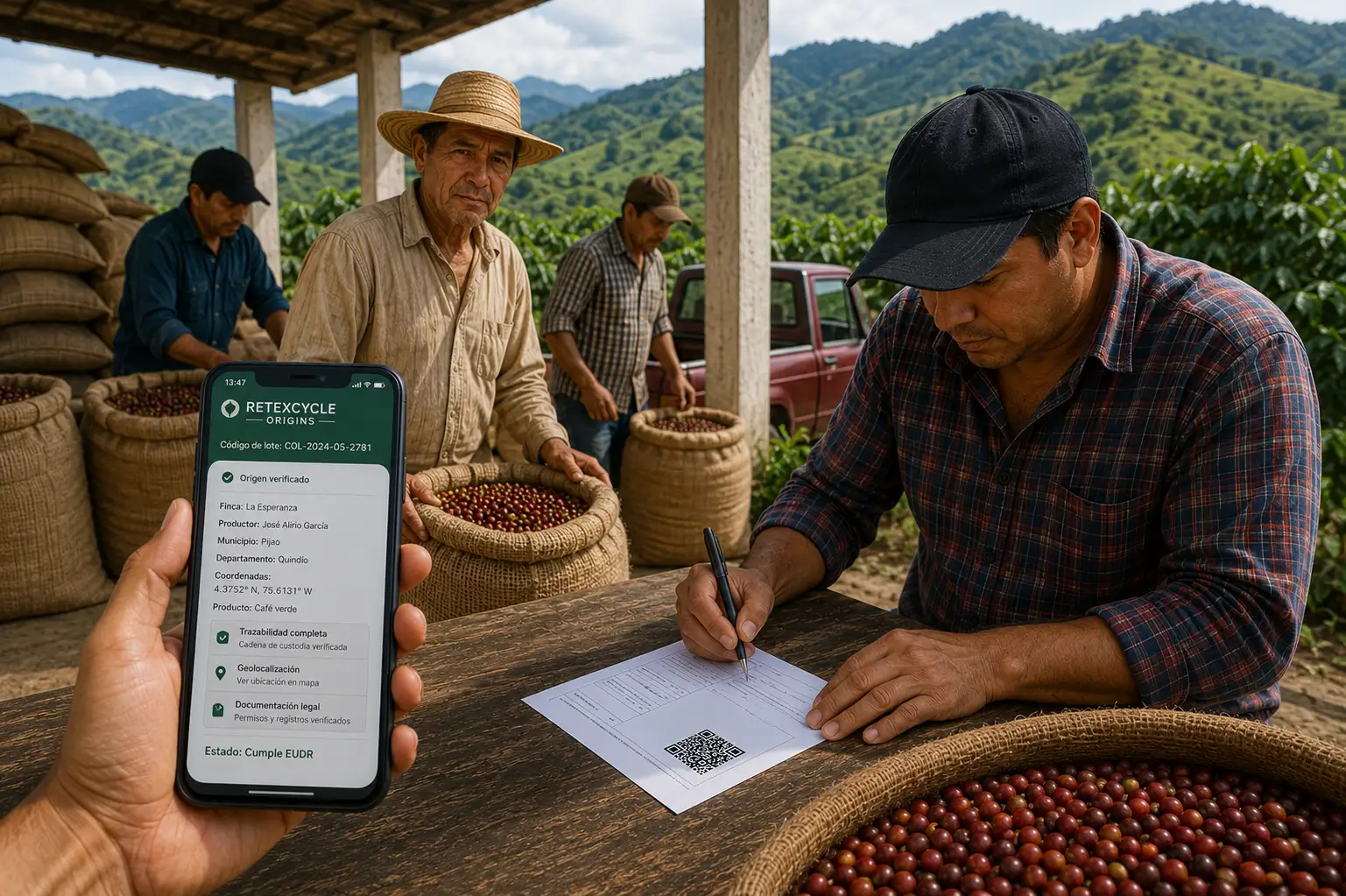
Retexcycle’s Compliance Hub organises origin, plots, DDS and their reference numbers by batch, so you can respond to an inspection without searching through emails and spreadsheets.
Frequently asked questions
Who enforces the EUDR in Spain?
According to MITECO, the national competent authority is the Directorate-General for Biodiversity, Forests and Desertification, and each autonomous community has designated its own. Customs authorities act at clearance (Arts. 14 and 26).
Will I be warned before an inspection?
Normally not: checks are carried out without prior notice, except where notification is necessary for the check to be effective (Art. 16(13)).
How many companies are checked?
Each Member State must check every year at least 3 % of operators and of non-SME downstream operators and traders if the commodities come from standard-risk countries; 9 % (and 9 % of the quantity of product) if they come from high-risk countries; and 1 % if they come from low-risk countries. The targets are met separately for each commodity (Art. 16(8) to (11)). These are minimums: the authority may also check on suspicion (Art. 16(12)).
How big can the fine be?
The Regulation does not set a figure. It requires fines proportionate to the environmental damage and to the value of the commodities and products, that remove the economic benefit of the infringement and rise for repeat offences. For legal persons, the maximum must be at least 4 % of annual total EU turnover (Art. 25(2)(a)). The specific amount in Spain will be set by national law, which has not yet been passed.
Has the Spanish sanctions law been passed?
There is no record of it. In June 2025 the Council of Ministers authorised the draft EUDR implementation bill, which creates the Office for the Fight against Trade-Associated Deforestation. No bill registered in Congress and no publication in the BOE were found as of 17/11/2026. Check the current status on MITECO's public consultation page.
From when can I be inspected and penalised?
Articles 3 to 13, 16 to 24, 26, 31 and 32 apply from 30 December 2026. Operators that are natural persons, micro or small enterprises and were established as such on 31 December 2024 have until 30 June 2027, except for the wood products of Regulation (EU) 995/2010 (Art. 38). Each State must also have its penalty regime in place (Art. 25(1)).
Does customs clearance protect me?
No. Release for free circulation or export is not considered proof of compliance (Art. 26(10)). The authority can inspect afterwards.
Can a third party report me?
Yes. Any natural or legal person can submit «substantiated concerns» to the authority (Art. 31). The authority must assess them without delay, may carry out checks and must inform the complainant of the follow-up within 30 days, unless national law provides otherwise. Member States must protect the identity of the person submitting them.
Verified on 17/11/2026 against the consolidated text of Regulation (EU) 2023/1115 on EUR-Lex (18/09/2026) and MITECO’s pages. Informational summary, not legal advice. Sources: Regulation (EU) 2023/1115; competent authorities (MITECO); draft bill (MITECO).